
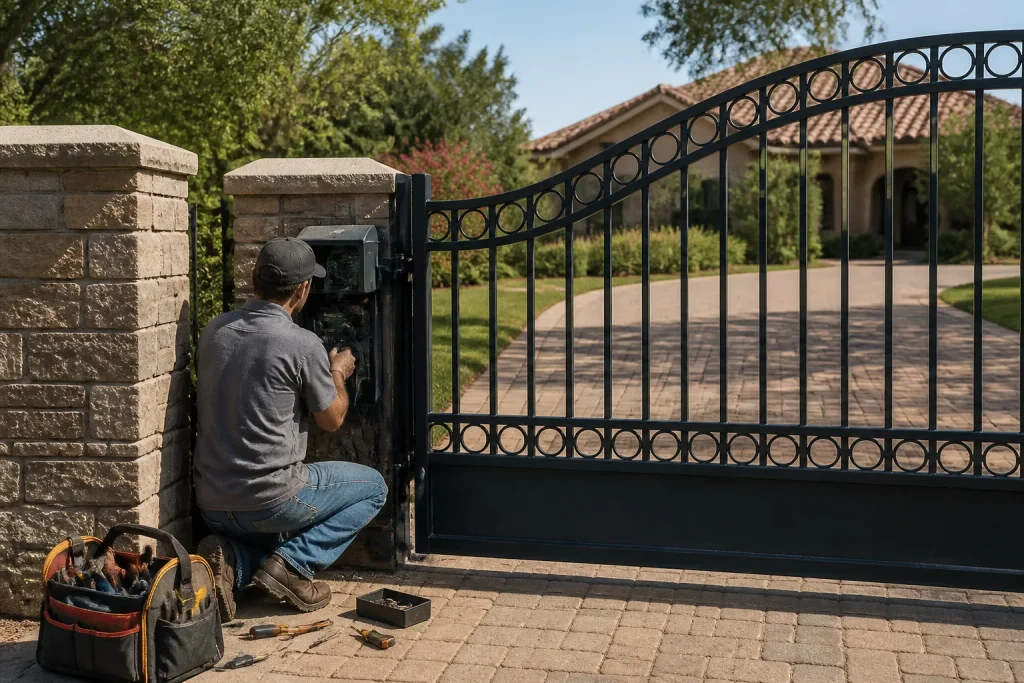
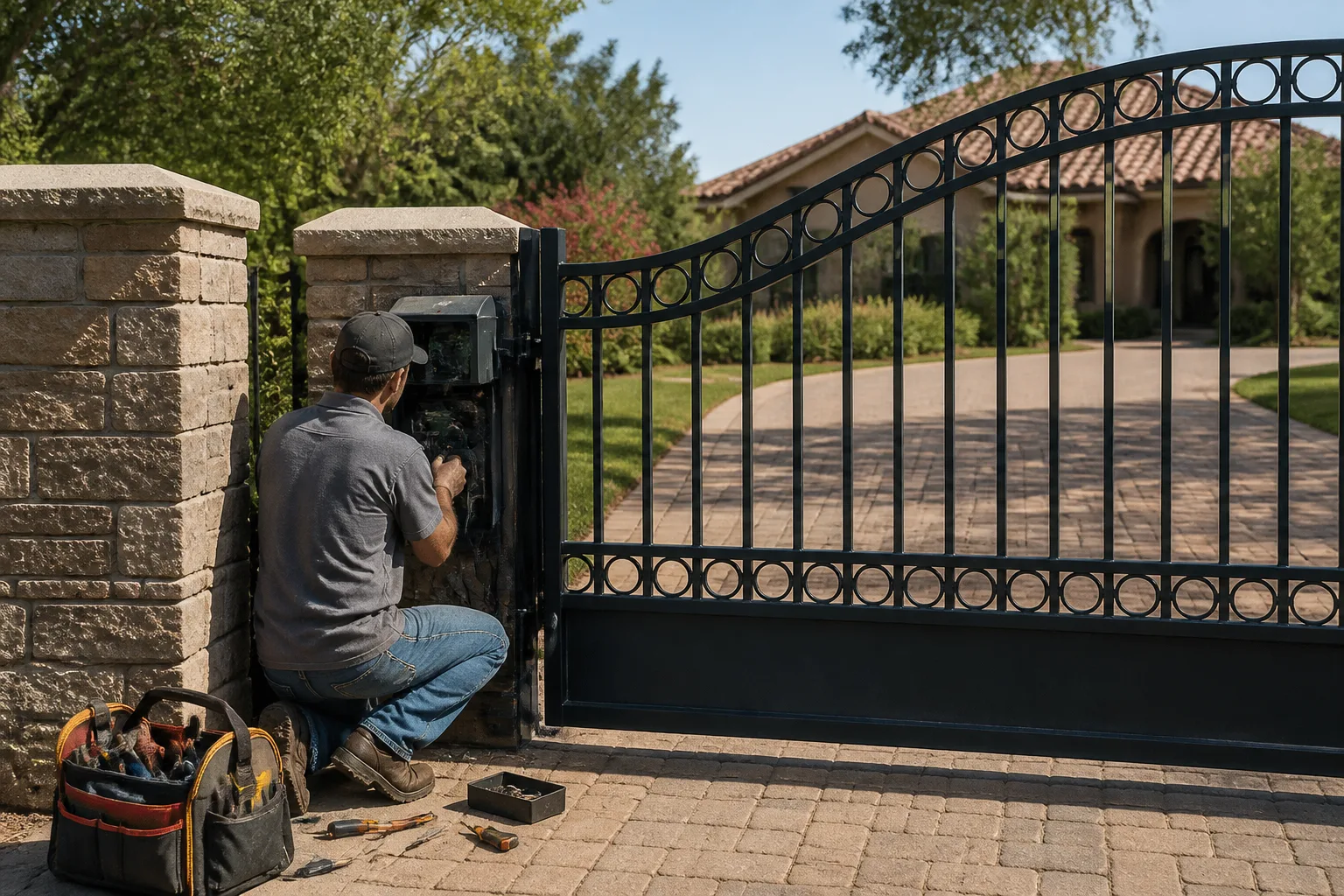
Gate Repair What It Really Costs: What Pocket Homeowners Pay in 2026
Most Pocket homeowners will pay between $250 and $950 for a gate repair in 2026, with the two biggest variables being whether the gate is manual or electric and whether the operator (the motor) is involved. A straightforward hinge rebuild on a manual gate might run $175 to $300, while a full operator replacement on an automatic driveway gate typically lands between $900 and $2,400 installed. If you’d rather skip the diagnostic guesswork and get a straight number, call us at (833) 620-5971 and we’ll walk you through what your actual gate needs before we quote anything.
The problem with gate repair pricing in Pocket isn’t that honest companies don’t exist. It’s that most quotes are built on gut feel, not a transparent parts-plus-labor breakdown, and that leaves homeowners comparing numbers that don’t mean the same thing. One company’s $400 quote is parts and labor. Another company’s $400 quote is a door-opener fee that covers showing up, with the real invoice arriving after the gate is disassembled in your driveway.
We write our invoices the way the work actually happens: trip fee, time, parts. That’s the whole anatomy. And once you know what each layer should cost, you can price-check any quote in Pocket with confidence.
What Drives Gate Repair Costs in Pocket
Three things determine what you’ll pay in Pocket, and none of them are mysterious. Labor, parts, and what kind of gate you have. That’s it. The rest of what you read online about “unexpected costs” is usually just a company that didn’t explain the quote before the truck pulled up.
Labor rates in the Sacramento area for gate technicians generally run $85 to $150 per hour, with a specialist landing at the higher end. You’re not paying for time in the truck. You’re paying for someone who can put hands on a LiftMaster control board, recognize the failure mode in ninety seconds, and have the right part in the van. That diagnostic speed is real money saved, and it’s exactly why a generalist’s lower hourly rate doesn’t always translate to a lower final invoice.
Parts are where most homeowner confusion lives. A FAAC hydraulic actuator for a swing gate costs materially more than a generic linear actuator from an online retailer. In our experience at Gate Repair in Pocket, the difference in lifespan usually justifies the cost, but you should know what you’re being sold either way. We’ll get into markup practices in a minute.
The gate type sets the floor. Manual steel swing gates are the cheapest to repair because there are fewer components to fail. Slide gates carry more load and wear rollers and chains. Electric gates, which dominate most of Pocket’s newer subdivisions along the levee, add a control board, limit switches, safety sensors, and a power source on top of everything mechanical. When an electric gate fails, the problem can live in the mechanical side, the electrical side, or the communication between the two. That diagnostic split is why electric gate repair costs more to assess before anyone even turns a wrench.
What Pocket Homeowners Actually Pay: 10 Common Repairs
Here’s the part most articles skip: real numbers for specific repairs, not “call for pricing” or a vague $200 to $2,000 range that’s mathematically true and practically useless. These reflect what we see on invoices across Pocket and the broader Sacramento market in 2026, for residential gates in average condition.
- Hinge rebuild (manual swing gate): $175 – $300. Sagging gate, dragging corner, latch that no longer lines up. Usually half a day of labor plus heavy-duty hinges and shims.
- Operator replacement (automatic swing or slide): $900 – $2,400. The wide range reflects brand. Entry-level Mighty Mule operators sit near $900 installed. A commercial-grade LiftMaster or BFT unit with more torque and duty cycles pushes toward $2,400. You’re also paying for programming, limit setting, and safety sensor recalibration.
- Control board swap: $300 – $750. The board is the brain. Lightning strikes, power surges from winter storms rolling into Pocket, and failed capacitors are the usual culprits. The board itself is $150 to $500 depending on brand, plus diagnostic and install time.
- Actuator replacement (swing gate): $450 – $1,100. The actuator is the arm that physically moves the gate leaf. FAAC hydraulic actuators run higher than basic electromechanical units, but they handle Pocket’s heat cycles better than cheap alternatives.
- Safety sensor realignment: $120 – $250. Gate reverses or won’t close? Often a misaligned or dirty photo eye. This is the cheapest fix with the most expensive consequence if ignored – a gate that reverses unpredictably is how vehicles and people get caught.
- Wiring repair: $150 – $400. Exposed low-voltage wiring along fence lines takes abuse from rodents and weed trimmers. This can be deceptively time-consuming to trace.
- Post realignment: $200 – $600. A leaning post means the gate’s entire geometry is off. Involves digging, resetting in concrete or gravel, and re-hanging the gate. Often mistaken for a hinge problem.
- Access control reprogramming: $100 – $300. Keypad codes, remote transmitters, intercom systems. When a homeowner moves into a Pocket property and the previous owner’s codes still work, this is the first call we make.
- Battery replacement (solar or backup systems): $80 – $250. Many Pocket properties run on solar-powered gate systems. Batteries degrade in Sacramento heat faster than manufacturers’ five-year estimates suggest.
- Roller or wheel replacement (slide gate): $150 – $400. Worn rollers make a slide gate grind and eventually bind. The rollers themselves are cheap; the labor to lift and align the gate isn’t.
If you need help figuring out where your gate falls, call (833) 620-5971 and describe what you’re hearing and seeing. We’ll tell you what’s likely and what it’ll cost to confirm.
Manual vs. Electric: The Cost Split Nobody Explains
A manual gate is a steel frame, two hinges, a latch, and gravity. Repairs are mechanical and predictable. An electric gate repair in Pocket involves every mechanical component plus an operator, a control board, safety edges or photo eyes, limit switches, wiring, and either line voltage or a solar panel with a battery bank. The difference in repair cost between these two worlds isn’t about one being “better” – it’s about one having literally ten times the failure points.
This is also where we see the biggest pricing mistakes from non-specialists. A handyman will quote a manual gate hinge rebuild accurately. But when that same handyman diagnoses an electric gate that won’t close, the quote frequently misses the failing limit switch and addresses the symptom instead of the cause. The gate works for a week, then the same problem returns. Now the homeowner has paid twice: once for the wrong repair, once for the right one.
Gate specialists, not generalists, develop pattern recognition across hundreds of identical failures. That’s not marketing language. That’s the difference between knowing that a LiftMaster operator making a clicking sound near the board usually means a bad capacitor, versus spending an hour testing every component on the gate. The hour costs money either way, but the specialist spends it from experience and the generalist spends it from a YouTube tutorial.
Decoding the Quote: What Should Actually Be on It
Here’s how to read any gate repair quote you get in Pocket. A legitimate invoice has line items you can verify. A vague quote is a negotiation in disguise.
Line items that should always appear:
- Trip or diagnostic fee (typically $50 to $120 in Pocket, often waived if you approve the repair)
- Labor hours with a stated hourly rate
- Each part with a brand name and whether it’s OEM or aftermarket
- Any permits, if applicable (rare for repairs, more common for new installations)
- Total, with a note on what would void the estimate
Red flags on gate quotes:
- “Labor and materials” as a single line item with no breakdown. You can’t verify either number.
- A trip fee quoted without clarifying whether it’s applied to the repair. Some companies charge both.
- “We’ll see once we get in there” with no worst-case ceiling. An honest tech gives you a range and calls before exceeding it.
- Replacing the entire operator when a control board or gear is the actual failure. We diagnose first, replace only when repair won’t last. It’s the difference between a $350 fix and a $1,800 replacement.
Our rule at Gatehouse is simple: the price we quote is the price you approve before any work starts. No surprises, no “while we had it open we noticed.” If we find something during the repair, we call, explain it with photos, and get verbal approval before touching it.
Specialist vs. Handyman: The 24-Month Math
Let’s talk about the number that actually matters, because it’s not the number on the first invoice. It’s the number on the 24-month total.
A handyman quoted $180 to rebuild a sagging hinge on a Pocket homeowner’s gate last year. The hinge was cheap, the labor was cheap, and the gate worked for about eight months. Then it sagged again. Then the latch broke. Then the post pulled under the repeated stress. By month 18, that homeowner had spent $680 across three separate calls.
A proper hinge rebuild with the right hardware and post assessment might have been $275 on day one, and the gate would still be square today. That’s the specialist’s whole argument in one story: the lowest upfront quote is often the most expensive repair you’ll ever buy.
Repeat-call rates are highest on four specific repairs, and every one of them is a spot where cheap labor gets exposed: hinge rebuilds (wrong hardware, wrong alignment), control board swaps (aftermarket boards with shorter lifespans), safety sensor work (aligned but not calibrated to the operator’s tolerance), and wiring repairs (spliced instead of replaced, corroding underground within months).
When the same gate problem comes back twice, the problem wasn’t the gate. It was the diagnosis. And we’ve never once seen a cheap diagnosis followed by an expensive, correct repair. The two go together.
We pulled one out of a garage over in the Pocket Canal area where a Mighty Mule operator had been “repaired” three times in one year by a well-meaning handyman. By the time we got there, the homeowner had replaced the remote, the battery, and the transformer. The actual problem was a failed limit switch that cost about $40 in parts. Three prior calls, zero correct diagnoses. That’s what generalized gate service looks like.
OEM vs. Aftermarket Parts: When It Matters, When It Doesn’t
Parts markup is where a lot of gate companies make their margin, and it’s also where a homeowner can get taken without ever knowing it.
Here’s the honest picture. OEM parts (original equipment manufacturer, meaning the part made by or for FAAC, BFT, LiftMaster, or whoever built your system) cost 30 to 80 percent more than aftermarket equivalents. A fair markup on parts is 10 to 30 percent over what the company pays wholesale, which reflects the cost of carrying inventory and the risk of a return.
Aftermarket parts are fine in some applications. Rollers, hinges, brackets, gate hardware: if it’s structural steel and a reputable brand, buy the cheaper option and sleep fine. Where aftermarket gets dangerous is in electronics and actuators. A $75 aftermarket control board for a BFT operator will almost always fail earlier than the $280 OEM board. We’ve replaced enough of both to know.
Ask your tech one question: “Is this part OEM or aftermarket?” A company that’s proud of its work will tell you, explain why they chose it, and stand behind it. A company that dodges the question is pricing OEM and shipping aftermarket, and the gap between those two numbers is their hidden margin.
We work on your brand, whatever it is, which means we’re not steering you toward a system we prefer to sell. We repair the gate you already have, with the right parts for that system. Sometimes that’s OEM. Sometimes aftermarket is genuinely the better value. The point is you’ll know which one you’re paying for.
Is a $89 Service Call Ever Legitimate?
Let’s address the hook directly, because Pocket homeowners see those ads constantly. A $89 “service call” is legitimate if the company tells you upfront that it’s a trip fee that covers travel and the first 15 to 30 minutes of diagnosis, and that it’s applied to your repair if you approve the work. That’s a fair structure, and many good companies (us included) use something similar.
It’s not legitimate when the $89 is positioned as the total cost, and then the technician arrives, diagnoses a “major problem,” and the real quote is $1,400 for work that should cost $400. That’s a bait-and-switch, and it’s endemic in the home service industry far beyond gates.
The defense is simple: ask what the service call includes before anyone drives to your house. Thirty seconds of conversation will separate honest operators from the rest. If they can’t articulate what $89 buys you, hang up and call someone who can, like us at (833) 620-5971.
How Pocket’s Climate Affects Gate Reliability
Pocket sits tight against the Sacramento River, and that geography shows up in gate failures in ways that never make the generic blog articles. The summer heat, running 95+ degrees for weeks, kills electronic components faster than anywhere with cooler nights. Capacitors swell. Solar battery banks degrade. Plastic gears strip. If your gate operator is in direct afternoon sun, it’s running hot for hours a day, and that heat is doing the damage you’ll pay for later.
Winter is gentler in Pocket than in the foothills, but the wet season brings a different problem: moisture. Poorly sealed control boards corrode, especially in the older subdivisions near the levee where fog hangs in the morning. Low-voltage wiring splices fail underground. Gate posts set in clay-heavy soil shift with the wet-dry cycle, pulling the gate out of alignment.
None of this should scare you. It should tell you that a gate repair quote from a technician who understands Pocket’s specific conditions is worth more than a cheaper quote from someone three cities away who’s never worked a gate by the river. Local knowledge is a real cost line. You just won’t see it printed on the invoice.
When to Call a Pro
You can adjust a latch, tighten a bolt, and clean a photo eye. But if your gate is electric, anything involving the operator, the control board, wiring, or safety systems is a job for someone with training and liability insurance. These systems carry enough force to injure someone, and a misaligned safety sensor or a badly wired actuator isn’t a nuisance – it’s a hazard. If the gate is heavy, automatic, or failing unpredictably, stop guessing and call us at (833) 620-5971. We’ll diagnose it honestly and give you a number before any work begins.
The Bottom Line
Gate repair in Pocket costs between $250 and $950 for most residential jobs, with operator replacements running $900 to $2,400 and simple mechanical fixes like hinge rebuilds running $175 to $300. The difference between a fair price and a bad one isn’t luck. It’s knowing what parts cost, what labor should cost, and what a legitimate quote looks like. Ask for line items. Ask about OEM versus aftermarket. Get the diagnostic scope before anyone arrives. If you’re in Pocket and need help, Gate Installation in Pocket might be relevant if repair turns into replacement – and we’ll tell you honestly which one you need. For repair work on your existing gate, call (833) 620-5971 for a free estimate. We’re Gatehouse Gate Repair, gate specialists serving Pocket, and we’d rather earn your call with a real number than win it with a fake one.
Frequently Asked Questions
How much does gate repair cost in Pocket, CA in 2026?
Most Pocket homeowners pay between $250 and $950 per repair. Simple mechanical fixes like hinge rebuilds run $175 to $300. Electric gate repairs involving control boards, actuators, or wiring run $300 to $1,100. Full operator replacements run $900 to $2,400. The price depends on whether your gate is manual or electric and which component failed. Call (833) 620-5971 for an exact quote on your gate – estimates are free.
Why do gate repair quotes vary so much between companies?
Because some companies price by gut feel and some price by parts-plus-labor. A vague “labor and materials” line item hides the breakdown. A transparent quote shows trip fee, hourly rate, each part with brand name, and the total. Also, OEM parts cost 30 to 80 percent more than aftermarket, and companies that quote OEM but install aftermarket are padding margin. Ask which you’re getting.
Is a handyman cheaper than a gate specialist?
On the first invoice, often yes. On a 24-month basis, frequently no. Cheap repairs on hinges, control boards, safety sensors, and wiring have the highest repeat-call rates in the industry. A $180 hinge job that fails in eight months and causes $500 in downstream damage is more expensive than a $275 rebuild done right the first time by someone who works on gates every day.
Can you fix my electric gate the same day?
Many common electric gate repairs, like sensor realignment, wiring fixes, and control board swaps, can be completed in a single visit. Operator replacements and some actuator work may require parts ordering if the brand isn’t in stock. Call (833) 620-5971 and describe what your gate is doing. We’ll tell you what’s likely, whether we can fix it same day, and what it’ll cost before we start.
Written by the team at Gatehouse Gate Repair, serving Pocket since 2018.
Need Gate Repair Help?
Call Gatehouse Gate Repair - licensed & insured, here with fast help in Pocket.
(833) 620-5971