
Last updated November 2, 2026
 Wrought iron
 Wood & steel frame
 Farm & ranch
 Sliding driveway gates
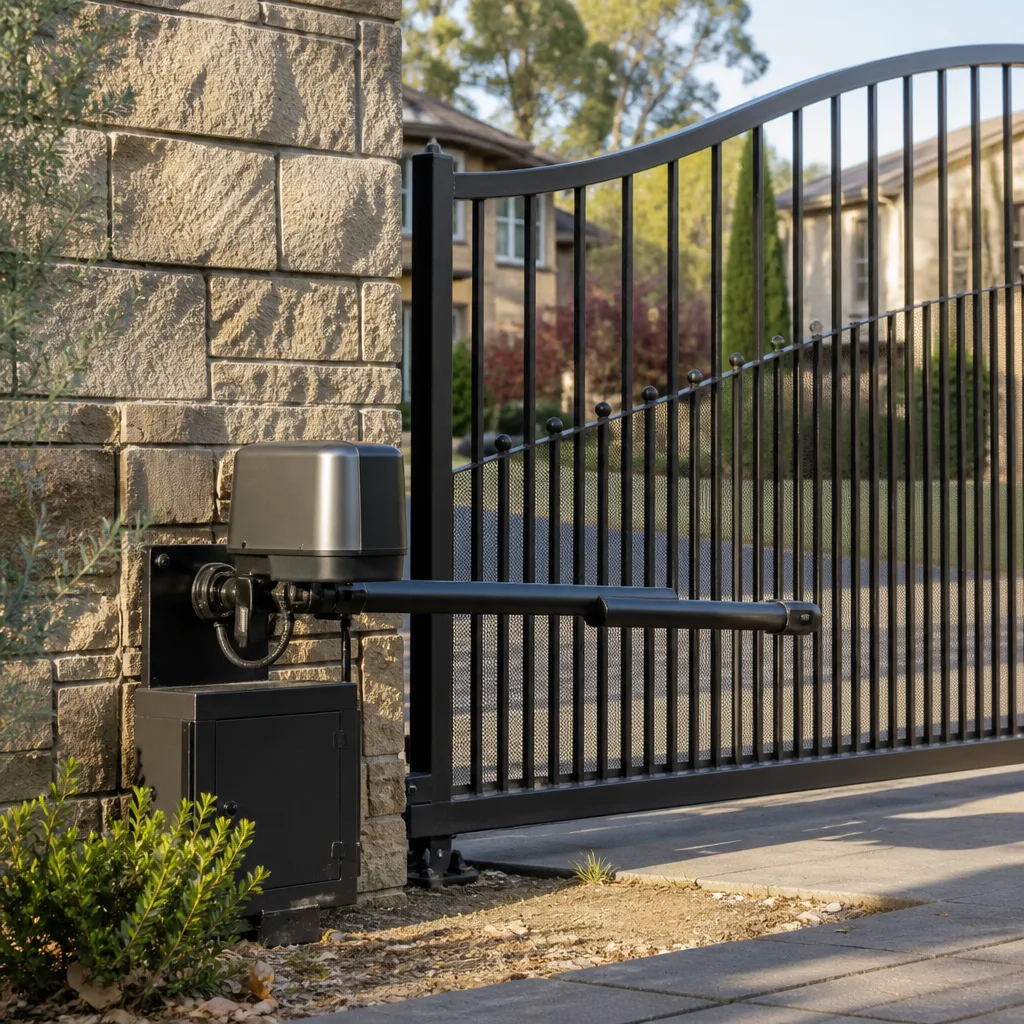 LiftMaster operators
Free on-site gate assessment - hinges, posts, and your LiftMaster or Nice gate operator checked before anything is quoted
The assessment is free and the quote is the invoice.
Get your free estimateGate Repair Emergency Preparedness Guide for Pocket Homes
Pocket has one primary road corridor off the peninsula. If your automatic gate fails closed during an emergency, knowing exactly what to do in the next 90 seconds is not optional. This is the Sacramento neighborhood where a stuck gate isn’t just an inconvenience, it’s a barrier between your family and the only evacuation route that matters. We’ve put together this guide because we provide Gate Repair services in Pocket every week, and we’ve seen what happens when a $40 part fails at the worst possible moment. By the time you finish reading, you’ll know how to manually release five major gate operator brands, what to tell a technician so they arrive with the right parts, and how to set up your system so a power outage never traps you behind your own gate. Let’s get into it, because this is one of the few home systems where preparedness can genuinely save lives.
Quick Answer
A gate stuck in the closed position during a Pocket emergency is solvable in most cases by locating the manual release mechanism on your operator, disengaging it, and pushing the gate open by hand. Every automatic gate operator sold in the last 20 years has a manual release, usually a pull handle or keyed override near the motor. If you have not tested yours, do it this weekend, because the middle of an evacuation is the wrong time to discover yours is rusted shut.
Styles & brands we work with
- Wrought iron
- Wood & steel frame
- Farm & ranch
- Sliding driveway gates
- LiftMaster operators
Table of Contents
- How to Manually Release Five Major Gate Operator Brands
- Battery Backup Systems for Pocket Homes: What Actually Works
- Creating an Emergency Gate Access Card for First Responders
- SMUD Power Outage Patterns and Your Gate’s Fail-Safe Setting
- The 24/7 Emergency Gate Repair Call Protocol
- Pre-Season Gate Evacuation Checklists
- Common Mistakes to Avoid
- When to Call a Professional
- Frequently Asked Questions
How to Manually Release Five Major Gate Operator Brands
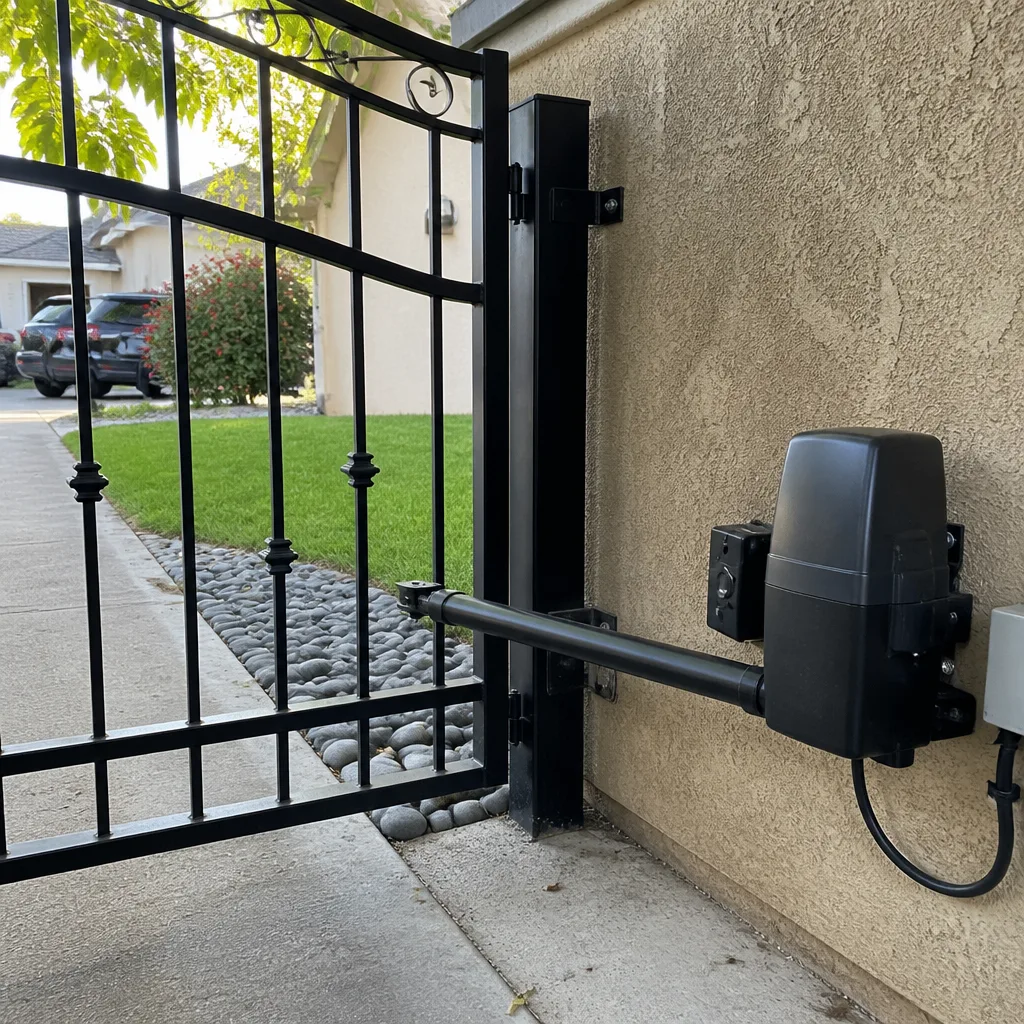
The manual release is the single most important safety feature on your gate, and the procedure varies enough between brands that guessing in the dark is a recipe for frustration. Here is what we tell every Pocket homeowner who calls us about a gate stuck closed. The critical difference to understand first: swing gates and slide gates release differently. A swing gate operator typically disengages the arm from the gate leaf, letting the gate swing free. A slide gate operator usually has a clutch or release that disconnects the drive chain from the motor, and you may need a release wrench or key to unlock the cover first.
LiftMaster
- Locate the operator, usually a square metal box mounted on the gate post or a side housing.
- Find the manual release pull handle, typically a red or yellow cord or a T-handle lever on the bottom or side of the operator housing.
- Pull the handle or rotate the lever counterclockwise until you hear a click. This disengages the motor.
- Push the gate by hand. LiftMaster swing arms sometimes need to be separated at the clevis pin if the arm does not release at the motor.
FAAC
- Look for a small plastic or metal keyhole on the top or side of the housing. FAAC operators usually include a dedicated release key that fits this lock.
- Insert the key and turn it to unlock the release mechanism.
- Lift or slide the release tab. On swing models, this separates the actuator from the gate leaf.
- Push the gate manually. Re-engage by reversing the process once power returns or the fault clears.
BFT
- BFT swing operators often have a release lever at the base of the ram or behind a small access door on the housing.
- Pull the lever toward you or to the side, depending on the model, until the piston can be extended or collapsed by hand.
- Some BFT slide operators require a crank handle that inserts into the top of the motor to manually wind the gate along its track.
- Once released, move the gate slowly. The hydraulic ram will still offer resistance if the hydraulic fluid is cold, which happens regularly on winter mornings in Pocket.
Ghost Controls
- Ghost Controls swing operators are mechanical arms that bolt to the gate and the post. The release is a small spring-loaded pull pin near the mounting bracket.
- Pull the pin out and rotate it 90 degrees so it stays disengaged.
- Push the gate open. This brand is designed for DIY installation, so the release action is simpler than hydraulic units.
- Re-engage the pin by rotating it back and letting it snap into the locked position.
Viking
- Viking slide gate operators are often used in commercial settings, but plenty of Pocket homes with wider driveways have them too.
- Open the cover with the release wrench provided with the unit. If you do not have the wrench, a large flathead screwdriver can open the cam lock in an emergency.
- Pull the manual release handle or rotate the clutch knob counterclockwise until the drive chain slackens.
- Push the gate by hand along its rail. Viking gates are heavy, and you may need two people for a cantilever-style slide gate.
If you test this today and find the release is frozen, broken, or missing a key, call us before the next storm season. We diagnose first, replace only when repair won’t last. For anyone in Pocket whose gate is already stuck, see our Gate Repair in Pocket page for what happens next.
Battery Backup Systems for Pocket Homes: What Actually Works
Battery backup on an automatic gate is not a luxury in Pocket. It’s the difference between a gate that opens during a SMUD outage and a gate that seals your driveway shut. But here is the failure mode most homeowners never hear about: backup batteries degrade silently while the power is still on, and you only discover the battery is dead when the power fails and the gate does nothing. A battery that has not been load-tested in three years will often show a green “ready” light while holding less than 20% of its actual capacity. We have replaced dozens of these in Pocket where the homeowner assumed they were protected.
Sizing for Your Operator
Most residential swing gate operators with a single leaf require a 12-volt 7Ah or 8Ah sealed lead-acid battery. Larger or dual-leaf swing gates and slide gate operators typically need 12-volt 12Ah or higher, or a pair of batteries wired in series for 24-volt systems. Check the label on your operator or the inside of its cover for the manufacturer’s specified backup battery size. Using a smaller battery shortens emergency runtime and can damage the charger circuit over time.
Testing Frequency
- Unplug the operator from AC power or switch off the breaker feeding the gate.
- Cycle the gate open and closed using battery power only.
- If the gate runs slower than normal or fails mid-cycle, the battery needs replacement.
- Test every six months. Set a calendar reminder. Pocket’s heat waves in July and August shorten sealed battery life faster than the manufacturer’s typical three-to-five-year rating.
The Pocket-Specific Reality
SMUD outage data shows that Pocket experiences more sustained outages during winter wind events and summer heat-related transformer failures than many other Sacramento neighborhoods. The river and levee geography concentrates wind through the corridors, and the area’s older underground infrastructure in certain subdivisions has been through several major repair cycles. If your gate is your only vehicle exit, and you have an electric vehicle that also depends on charging at home, a functional battery backup should be treated as non-negotiable.
Creating an Emergency Gate Access Card for First Responders
If you are unconscious, evacuating, or not home when firefighters need access to your property, your gate becomes an obstacle unless you have planned for that exact moment. Sacramento County Fire and most local agencies do not keep a master key for residential gate operators, because there is no single key or code that works across brands. They rely on homeowners to provide access information in advance, or they use forcible entry, which damages your gate and delays help.
Here is what to create and post, according to what we advise clients in Pocket based on Sacramento County Fire access guidelines.
What to Include on the Card
- Your address in large, reflective lettering.
- A simple statement: “GATE MANUAL RELEASE LOCATED AT:” followed by the exact location, such as “rear of operator box to the right of the driveway” or “pull handle inside the wooden gate pillar.”
- The specific operator brand, if known, so responders know which release style to expect.
- A phone number for a neighbor or family member who can remotely open the gate if it has smart controls.
- Do not put your gate code on a publicly visible card. If the gate has a keypad or remote app access, note that a code exists and that emergency dispatch can contact the listed number for it.
Where to Mount It
- Mount the card on a post inside a weatherproof sleeve, at eye level, on the outside of the gate near the operator.
- Choose a location visible from the street but not reachable from outside the property, if possible. Some Pocket homes mount the sleeve just inside the pedestrian gate where it can be reached through the bars.
- Use a reflective sleeve so it is visible in smoke, fog, or darkness. Pocket gets tule fog in late fall that drops visibility near the river to under a hundred feet.
- Do not mount the card to the gate leaf itself. The gate moves, and the card swings out of reach or gets crushed when the gate operates.
For electric gate systems with access control, a first-responder override feature is possible on some brands. Our Electric Gate Repair in Pocket service covers this exact configuration, and we can advise whether your operator supports a fire department key switch or Knox box integration.
SMUD Power Outage Patterns and Your Gate’s Fail-Safe Setting
Your operator has a setting that tells it what to do when it loses AC power while running on the backup battery or not at all: default-open or default-closed. Most residential operators ship from the factory in the default-closed position, because the manufacturer assumes security is the priority. For a Pocket homeowner, that assumption may be wrong, and it is a decision you should make deliberately rather than accepting by default.
Default-Open: The Evacuation Priority
- How it works: When power is lost, the gate opens and stays open until power returns.
- Who should choose this: Any household that relies on the gate as the only or primary vehicle exit. Also anyone in a Pocket home near the river side of the highway 5 corridor where evacuation routes are already constrained.
- The tradeoff: An open gate during an outage means no barrier to anyone walking or driving in. If security during a blackout matters more than immediate exit, this setting is not for you.
Default-Closed: The Security Priority
- How it works: The gate stays closed when power fails. It only opens if you manually release it or if a battery backup kicks in and you use the remote.
- Who should choose this: Households with secondary pedestrian exits, homes with extensive perimeter security needs, or anyone storing high-value equipment in the driveway.
- The tradeoff: If the manual release fails, you are trapped until a technician arrives or you cut through the fence.
Programming the Setting
This is done through the operator’s control board or its smartphone app, depending on the brand. FAAC, LiftMaster, and Ghost Controls all handle this differently, which is why we recommend you document the change in your gate manual. If you do not know how to change it, we can do it during a routine service call, and we will walk you through the implications for your specific gate type and driveway layout.
The 24/7 Emergency Gate Repair Call Protocol
When you call a gate repair company with a gate stuck closed, the information you give in the first 90 seconds determines whether the technician arrives with the right parts or spends the visit diagnosing and leaves to get what they need. Here is what to say, in order, based on what our technicians ask first.
- State your address and that it is an emergency. “Gate stuck closed” is the phrase that triggers emergency dispatch.
- Give the operator brand and model if you can read it. The model number is on a sticker inside the cover or on the side of the housing.
- Describe the gate type: swing or slide, single or double leaf, and approximate weight if you know it.
- Describe the symptom in plain words: “The motor hums but the gate doesn’t move” is different from “the remote makes a clicking sound but nothing happens” and different from “the gate is stuck halfway and the keypad is dark.”
- Say whether you have a battery backup and whether you have tried the manual release.
- If the gate is stuck open, say so clearly. A gate stuck open is a different priority than one stuck closed, and the technician may bring different parts.
Call (833) 620-5971 for fast dispatch from 7am to 7pm. We service Pocket homes with technicians who arrive with parts for the nine brands we support, so diagnosis happens faster and you are not waiting for a second visit.
Pre-Season Gate Evacuation Checklists
Run through this Gate Repair Maintenance Checklist for Pocket Homeowners twice a year: once before summer fire season, and once before winter storm season. Both seasons stress gate components differently, and Pocket’s location between the river and the freeway means you experience both sets of conditions.
Summer Fire Season Checklist
- Test the manual release on a cool morning, before the afternoon heat makes metal components expand and bind.
- Cycle the gate fully open and closed three times. Listen for grinding, squealing, or hesitation.
- Check the battery backup with a load test, not just a green indicator light.
- Lubricate hinges and the drive chain or screw. Use a heavy-duty silicone spray or white lithium grease, not WD-40, which displaces the existing lubricant.
- Verify the photo-eye sensors are clean and aligned. Pocket’s summer dust and spider webs block these sensors and cause the gate to refuse to close or to reverse mid-cycle.
Winter Storm Season Checklist
- Inspect the operator housing for water intrusion. Rains in Pocket can be intense but short-lived, and any crack in a housing seal lets moisture in that corrodes control boards over the winter.
- Check that drainage around the gate track or hinge posts is clear. Standing water softens the soil beneath slide gate rollers and causes misalignment.
- Verify the battery is fully charged and less than three years old.
- Test the gate’s operation at dawn, when the battery is at its weakest after a cold night.
- Ensure your first responder access card sleeve is still mounted and readable.
If any item on either checklist fails, or you are not comfortable testing electrical components, call us for a pre-season inspection. We are gate specialists, not generalists, and we work on your brand.
Common Mistakes to Avoid
- Never testing the manual release until an emergency happens. The release mechanism rusts and binds over time, especially in Pocket’s winter dampness. If you cannot operate it in calm conditions, you will not be able to operate it in a smoke-filled evacuation.
- Relying on a battery backup that was installed three or more years ago without load-testing it. A battery that reads “ready” can be at 20% capacity. We see this on nearly every older backup system we inspect in Pocket.
- Installing a pedestrian gate that requires a key to exit. During a fire evacuation, counting on finding a key is a failure point. Choose a pedestrian gate with a thumb-turn or push-bar exit on the inside.
- Programing the gate to default-closed on power loss without thinking through your evacuation route. Default-closed is the factory setting on most operators, not a deliberate choice. For many Pocket homes, default-open is the safer setting.
- Using generic lubricant on the gate track or hinges. WD-40 and similar sprays clean but do not lubricate, and they strip the protective film that prevents rust on steel components.
- Calling a general handyman or fencing company for an electric gate fault. Electric and automated gate repair requires electronics and low-voltage expertise. A company that installs fences as its main business does not stock FAAC or BFT control boards in the service van.
- Waiting to fix a gate that is getting slower every month. A gate that slows down is telling you something: the operator is straining, the battery is fading, or a hinge is binding. Early repair is cheaper than emergency replacement, and it never happens at noon on a Tuesday, it happens at 11pm the night before a big trip.
When to Call a Professional
Some gate problems are DIY-friendly, like lubricating hinges or cleaning photo-eye sensors. Others are genuinely dangerous or require specialized electronics diagnosis, and those are the ones to hand over. If you hear grinding metal from inside the operator, smell burning electronics, see sparks, or find that the gate has jumped its track and is leaning, stop using the gate and call for service. If the operator trips its breaker repeatedly, if the remote range degrades rapidly, or if the gate reverses direction for no reason, you are dealing with a control board or circuit issue that requires bench diagnosis and the correct replacement part. For any Gate Installation in Pocket needs, or a repair that requires you to choose between a rebuild and a replacement, we provide free estimates and a written price before any work begins.
Gatehouse Gate Repair offers free estimates in Pocket. Call (833) 620-5971 and tell us what your gate is doing. We will tell you whether it needs a service call or whether you can fix it yourself safely.
Frequently Asked Questions
Locate the manual release on your operator immediately. For most brands, pulling the release lever or handle disengages the motor, and you can push the gate open by hand. If you cannot find or operate the release, call (833) 620-5971 and tell the dispatcher your gate is stuck closed and you need emergency assistance.
Emergency gate repair costs vary depending on the operator brand, the failed component, and whether the gate is a swing or slide type. The best way to get an exact quote is to call (833) 620-5971 and describe the symptom. We quote a written price before any work begins, and estimates are free.
For gates that are stuck closed or otherwise preventing you from safely leaving your property, same-day service is available. Call (833) 620-5971 as early as possible, and describe the operator brand and symptom so the technician arrives prepared.
Residential swing gates typically use a 12-volt 7Ah or 8Ah sealed lead-acid battery, while slide gates and dual-leaf systems often require 12Ah or larger. The exact size is printed on the existing battery or listed in the operator manual. For a free estimate on a battery replacement in Pocket, call (833) 620-5971.
No. There is no universal key or code for residential gate operators because brands like LiftMaster, FAAC, and Ghost Controls all use different systems. You need to post an access card with your manual release location or provide a contact number for a neighbor who can open the gate remotely. We can advise on the best placement for your specific gate configuration.
A swing gate release typically disengages the operator arm from the gate leaf, allowing the gate to swing free. A slide gate release usually disengages the drive chain or uses a clutch mechanism, and the gate may be heavy enough that one person cannot easily move it. Betting on the release mechanism without knowing which type you have is a mistake, so test it before you need it.
The Bottom Line
An automatic gate is a machine with moving parts, electronics, and a battery, and all three will eventually fail. In Pocket, where the evacuation route off the peninsula is limited and the summer fire risk is real, a gate failure is not an inconvenience, it’s a safety problem. Know your manual release, test it twice a year, load-test your battery, and decide deliberately whether you want your gate to default-open or default-closed on power loss. For Gate Repair Permits, Codes & Inspections in CA: What You Need to Know, check our resource before making major changes. The 90 seconds it takes to release a gate manually can make the difference between a smooth evacuation and a bad situation. If anything in this guide raised a question you cannot answer about your own gate, call (833) 620-5971. We diagnose first, replace only when repair won’t last.
Written by the team at Gatehouse Gate Repair, serving Pocket since 2018. Explore more guides & resources on our blog.
See the difference
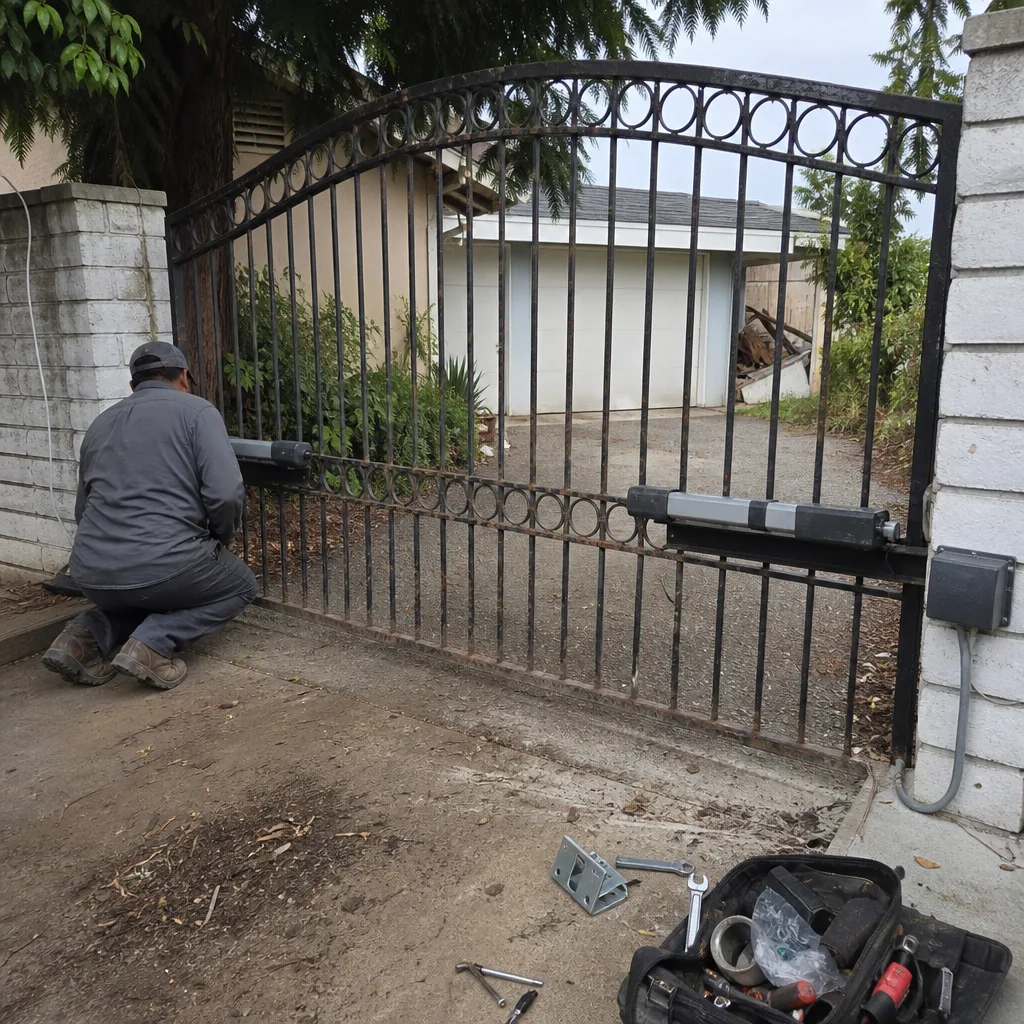 Before
 After
 Before
 After
 Before
 After