
Last updated November 3, 2026
 Wrought iron
 Wood & steel frame
 Farm & ranch
 Sliding driveway gates
 LiftMaster operators
Free on-site gate assessment - hinges, posts, and your LiftMaster or Nice gate operator checked before anything is quoted
The assessment is free and the quote is the invoice.
Get your free estimateThe Complete Gate Repair Guide for Pocket Homeowners
Most Pocket homeowners don’t have a gate problem. They have a diagnosis problem. The average homeowner in this neighborhood calls for gate service two or three times before someone identifies the actual root cause, because most technicians treat the symptom instead of the system. A gate that won’t open is rarely just a dead motor. It’s usually a chain reaction that started months earlier with soil movement, heat stress, or a misaligned hinge that slowly overloaded the operator until it failed. This guide explains how to read your gate as a complete system, what actually goes wrong in Pocket specifically, and how to stop paying for repeat repairs that never fix the real issue. For deeper reading, see The Complete Guide to Gate Repair in Pocket.
Quick Answer
Gate repair in Pocket, CA typically costs between $150 and $750 depending on whether the problem is mechanical (hinges, wheels, alignment) or electronic (control board, motor, sensors). Most gate failures in this neighborhood trace back to three root causes: Sacramento Valley heat stressing operator motors and warping frames, soil settling in Pocket’s older subdivisions throwing off hinge and post alignment, and HOA gate usage patterns that cause premature wear on shared systems. A proper diagnosis examines the whole system, not just the part that stopped working.
Styles & brands we work with
- Wrought iron
- Wood & steel frame
- Farm & ranch
- Sliding driveway gates
- LiftMaster operators
Table of Contents
- How Your Gate Actually Works: A System, Not a Machine
- The Three Pocket-Specific Causes of Gate Failure
- How Sacramento Valley Heat Damages Gates Differently
- Soil Settling in Pocket’s Older Subdivisions and What It Does to Hinges
- Repair vs. Replace: A Decision Framework for Pocket Homeowners
- Seasonal Gate Maintenance for Pocket’s Climate
- Common Mistakes to Avoid
- When to Call a Professional
How Your Gate Actually Works: A System, Not a Machine
A driveway gate is not one device. It’s five subsystems that have to work together, and when any one of them drifts out of spec, the others compensate until something fails. Understanding this is the difference between a $200 hinge adjustment and an $800 operator replacement that doesn’t solve the problem.
The Five Subsystems of Every Automated Gate
- The operator – the motor and gearbox that physically moves the gate. In residential Pocket installations, this is usually a LiftMaster, FAAC, BFT, or Mighty Mule unit mounted on a post or inside a housing.
- The actuator or drive mechanism – the arm, chain, belt, or screw that transfers motor power to the gate leaf. This is where misalignment shows up first.
- The safety sensors – photo eyes, edge sensors, and loop detectors that tell the gate to stop or reverse when something is in the path. These are the most common source of “ghost” problems where the gate reverses for no visible reason.
- The access control – keypads, remotes, intercoms, and vehicle detection systems. When this fails, the gate doesn’t respond to commands even though the mechanical side is fine.
- The structural frame – posts, hinges, wheels, and the gate leaf itself. This is the part Pocket’s soil and heat attack most aggressively.
When we talk about Gate Repair in Pocket, we’re talking about diagnosing which subsystem is actually failing. A gate that moves slowly could be a dying motor, but it’s just as often a hinge that’s binding because the post shifted a quarter inch. A gate that reverses randomly might have a bad edge sensor, but it could also be an actuator that’s out of alignment and tripping the safety system as a false reading. The symptom tells you something is wrong. The diagnosis tells you what.
The Three Pocket-Specific Causes of Gate Failure
Pocket is not a generic suburb. The neighborhood sits on specific soil types, experiences a specific climate pattern, and has a specific mix of older and newer homes with different gate installations. After years of working on gates in this area, we’ve identified three root causes that account for the majority of repeat service calls. None of them are what homeowners expect.
- Soil settling shifts gate posts by fractions of an inch. Pocket’s older subdivisions were built on soil that compacts and shifts with seasonal moisture changes. A post that moves even a quarter inch out of plumb changes the geometry of the entire gate. The hinge binds, the operator works harder, and eventually the motor burns out. The homeowner pays for a new motor, but the post is still crooked, so the new motor fails too. This is the single most misdiagnosed gate problem in Pocket.
- Summer heat cycles stress operator electronics and warp gate leaves. Sacramento Valley summers routinely hit 100°F, and gate operators sit in direct sun mounted to metal posts that get even hotter. Control boards and capacitors degrade faster in sustained high heat. Steel and aluminum gate frames expand and contract daily, and over several seasons, that thermal cycling can warp a gate leaf enough to throw off the latch or bind the hinge.
- HOA and shared-gate usage patterns create wear that single-family gates don’t see. Many Pocket homes are in communities with shared gates or gates that see 30 to 50 cycles a day instead of 5 to 10. That’s the equivalent of five years of residential use in a single year. Operators rated for residential duty cycles fail early when they’re asked to handle that volume, and the fix often requires a commercial-grade unit rather than another residential replacement.
These three causes matter because they change the repair strategy. If the post is drifting, replacing the operator is a waste of money. If the gate leaf is warping from heat, tightening the hinges won’t help. If the operator is under-spec’d for HOA traffic, a like-for-like replacement just resets the clock on another premature failure.
How Sacramento Valley Heat Damages Gates Differently
Gate manufacturers build for a national market, which means their temperature ratings are broad averages. But Pocket and the surrounding Sacramento Valley run hotter than most of the country for four to five months of the year. That heat does specific, predictable things to gate systems, and Pocket homeowners who understand this can catch problems before they become breakdowns.
What Heat Does to Each Gate Component
- Control boards: Capacitors and solder joints degrade faster above 120°F, and a black control box in direct Sacramento sun easily exceeds that. Symptoms: intermittent operation, resets, or complete failure on hot afternoons that resolves overnight.
- Operator motors: Heat increases internal resistance, which means the motor draws more current to do the same work. Over a full summer, that extra load shortens brush life and can trip thermal protection switches mid-cycle.
- Gate leaf frames: Steel and aluminum expand at different rates, so a gate with mixed materials (common on older Pocket installations) develops stress at the joints. Powder-coated steel is particularly vulnerable because the coating cracks as the metal flexes, letting moisture in.
- Batteries and backup power: Solar-charged battery backups on gates cook in direct sun. A battery in a black housing on a 105°F day can hit 140°F internally, which cuts its service life in half compared to shaded installations.
- Lubrication: Grease thins and runs out of hinges and bearing points in sustained heat, leaving metal-on-metal contact. By September, many Pocket gates are running dry.
Seasonal Inspection Checklist for Hot Weather
- In April, before the heat hits, check hinge bolts for torque and look for hairline cracks in the gate frame at weld points.
- In June, after the first heat wave, test the gate at midday and watch for sluggish movement or hesitation. If it’s slower at 3 PM than at 8 AM, the motor or control board is heat-stressed.
- In August, inspect the operator housing’s internal temperature if accessible, and check that thermal vents or cooling fins aren’t blocked by debris or spider webs.
- In October, after the worst heat has passed, re-lubricate hinges, wheels, and the actuator drive mechanism. Use a high-temperature rated grease, not standard lithium, for Pocket’s climate.
This is the kind of maintenance that Gatehouse Gate Repair performs as part of a service call, but homeowners who prefer to stay on top of things themselves can catch issues early with just a few minutes a month. The key is understanding that Sacramento heat is a persistent stressor, not a one-time event.
Soil Settling in Pocket’s Older Subdivisions and What It Does to Hinges
Pocket was developed in phases, and the older sections sit on expansive clay soil that swells when wet and contracts when dry. Over decades, this cycle shifts gate posts and fence posts a fraction of an inch at a time. A quarter inch of post movement at the hinge translates to a full inch or more of misalignment at the gate’s far edge. That misalignment is the root cause of half the “motor failures” we see in this neighborhood.
How to Tell If Your Gate Post Has Shifted
- The reveal (gap) between gate and fence is uneven top to bottom. If the gap is wider at the top than the bottom, or vice versa, the post is out of plumb.
- The gate sags toward the latch side even when the hinges are tight. This means the hinge post itself is leaning.
- The operator arm or actuator looks out of line with the gate – it’s pushing at an angle instead of straight on.
- The gate scrapes the ground or the concrete at one specific point in its swing arc, but not others.
- You’ve replaced the operator once already and the new one is already struggling. The post was never fixed, so the new motor is fighting the same mechanical bind.
When a post has shifted, the fix is not to adjust the hinges to compensate, because the post will keep moving. The correct repair is to reset the post in a proper concrete footing – ideally deeper than the original, with the soil compacted and the post re-plumbed. In some cases, a steel reinforcement plate or additional concrete collar around the base is enough. This is structural work, and it’s where fence companies and generalists often fall short. They’ll shim the hinge and call it done, and six months later the gate is binding again. Our Electric Gate Repair in Pocket service approaches this as a system issue: the electronics can’t work properly if the mechanical foundation is moving.
In Pocket’s older subdivisions, we recommend checking post alignment annually even if the gate is working fine. Catching a quarter-inch shift early means a $200 post stabilization instead of a $900 operator replacement plus the $200 post fix you should have done in the first place.
Repair vs. Replace: A Decision Framework for Pocket Homeowners
Every gate reaches a point where repairing it again is throwing good money after bad. But the decision isn’t as simple as “old gate, replace it.” The real question is whether the existing system can be made reliable for the next five years, or whether you’re going to keep paying for Band-Aids. Here’s the framework we use with Pocket homeowners when they’re facing this decision.
When to Repair
- The gate structure is sound. Posts are plumb, the leaf isn’t warped, hinges aren’t wallowed out. If the frame is good, a motor swap or control board replacement is a straightforward fix that extends the system’s life.
- The operator is a current model with parts available. LiftMaster, FAAC, BFT, and Linear all maintain parts support for older units, but there’s a threshold. If your operator was discontinued more than 10 years ago, parts availability becomes expensive and slow.
- The failure is isolated – one component failed, and everything else tests good. A bad photo eye on an otherwise healthy system is a repair, not a replacement.
- You’re planning to sell within 2-3 years. A functioning but older gate may be fine for the sale. The new owner can upgrade if they want.
When to Replace
- The gate leaf itself is warped or rusted through. No operator can fix a gate that’s fighting its own geometry. This is common in Pocket after 10-15 years of heat cycling on older steel gates.
- The posts have shifted repeatedly despite previous stabilization. If the soil won’t hold the post, the foundation itself needs re-engineering, and that’s the time to redesign the whole installation.
- The operator is undersized for actual usage. A residential operator on an HOA gate that cycles 40 times a day will keep failing. The right fix is a commercial-grade operator matched to the duty cycle.
- You want new features – smartphone access, battery backup, a quieter operator, or a different access control system. At a certain point, retrofitting costs more than a clean installation.
- The cumulative repair spend over the last three years exceeds 60% of a new installation. At that point, you’re maintaining a system that’s already told you it’s done.
If you’re leaning toward replacement, our Gate Installation in Pocket service handles everything from removing the old gate to pouring new footings and programming the new access control. We work with equipment from nine major brands, so we’ll recommend the right operator for your specific gate weight, usage pattern, and budget – not whatever brand we happen to sell exclusively.
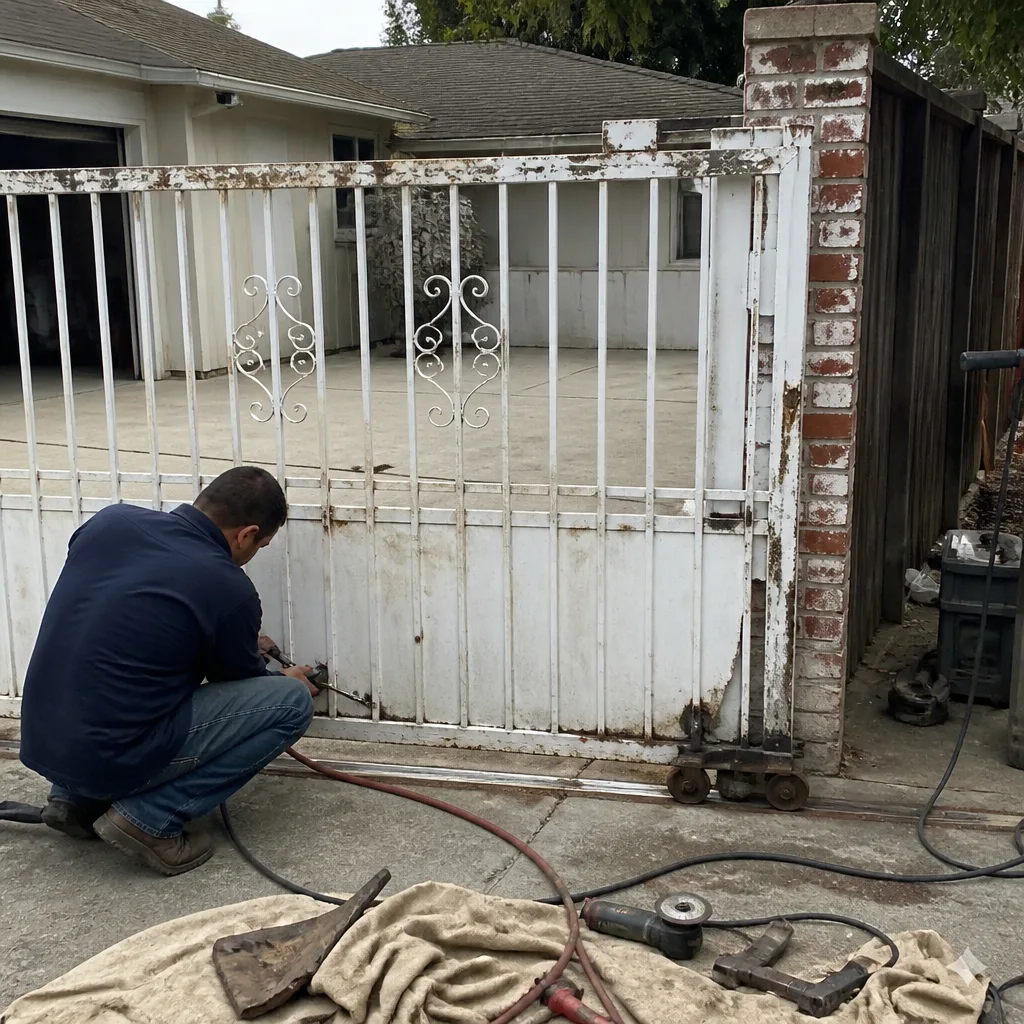
See the difference
 Before
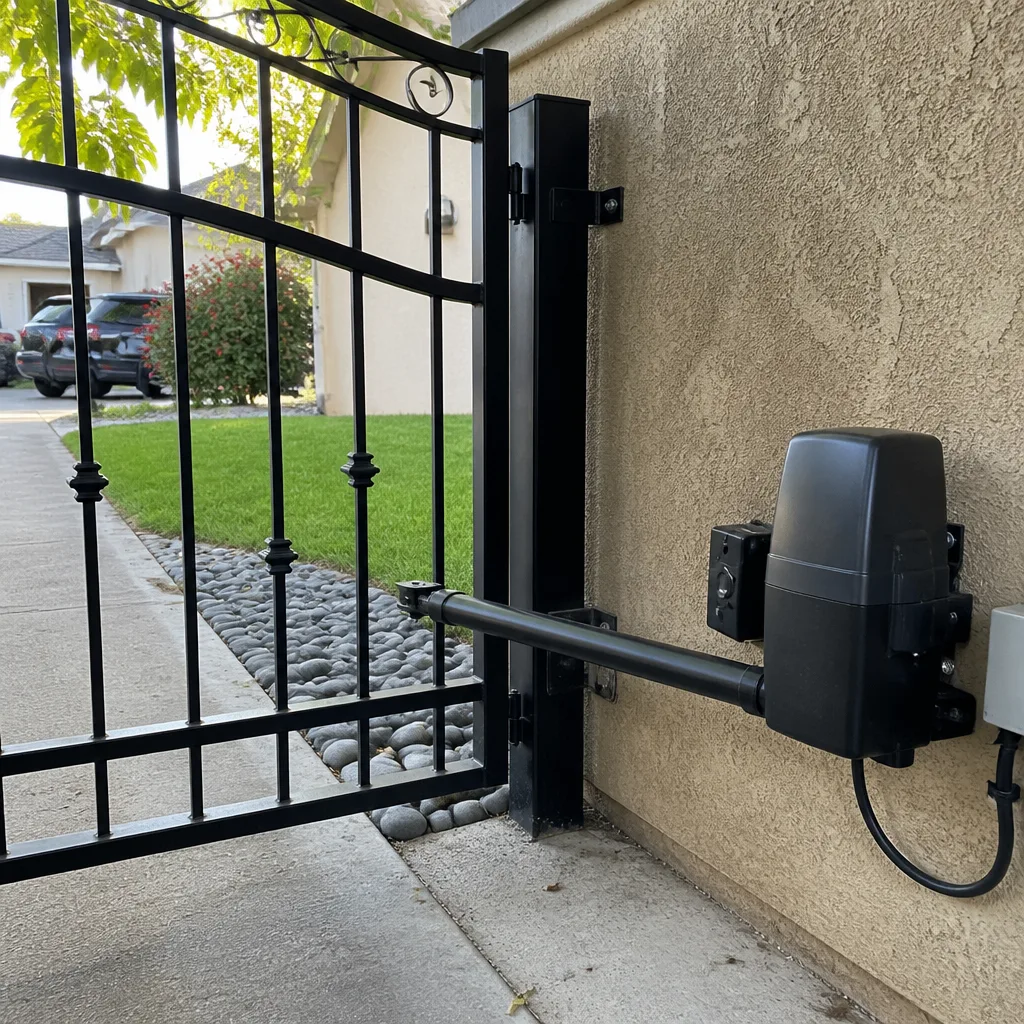 After
 Before
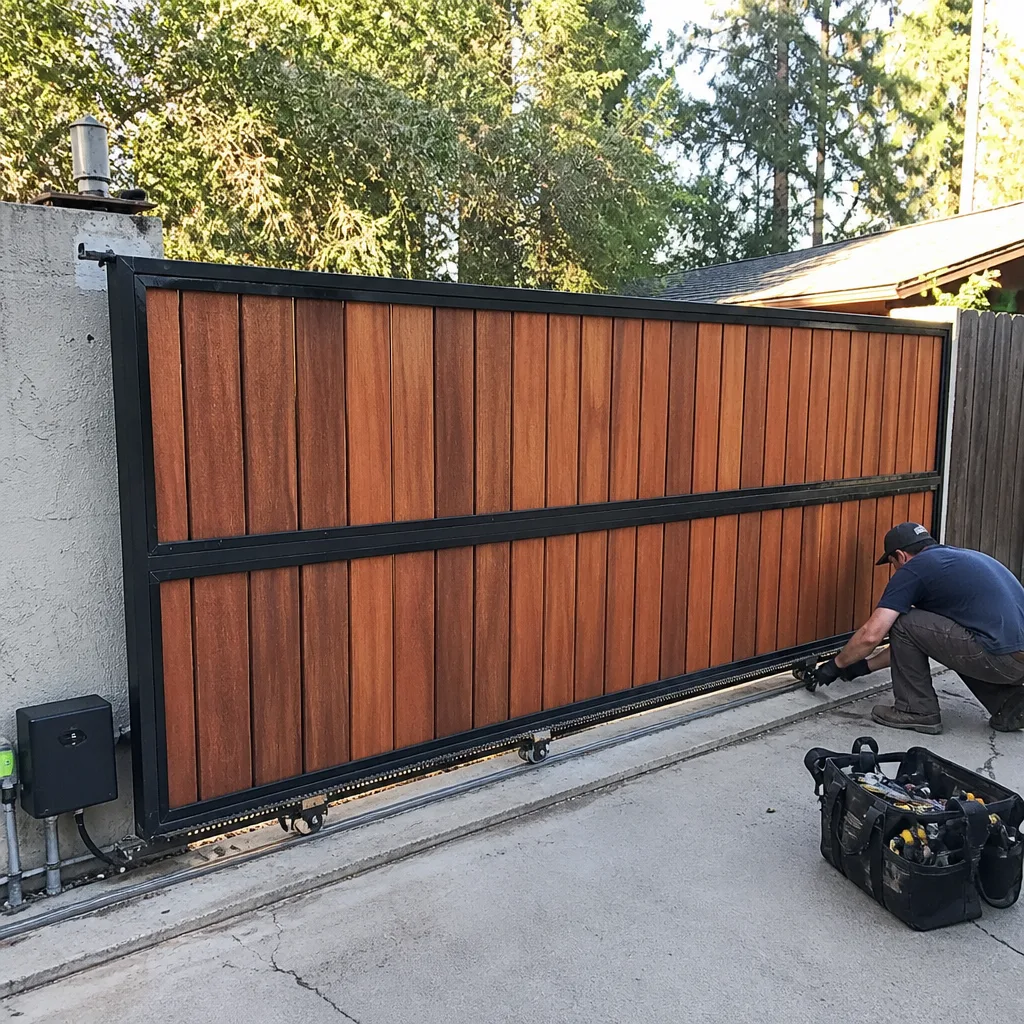 After
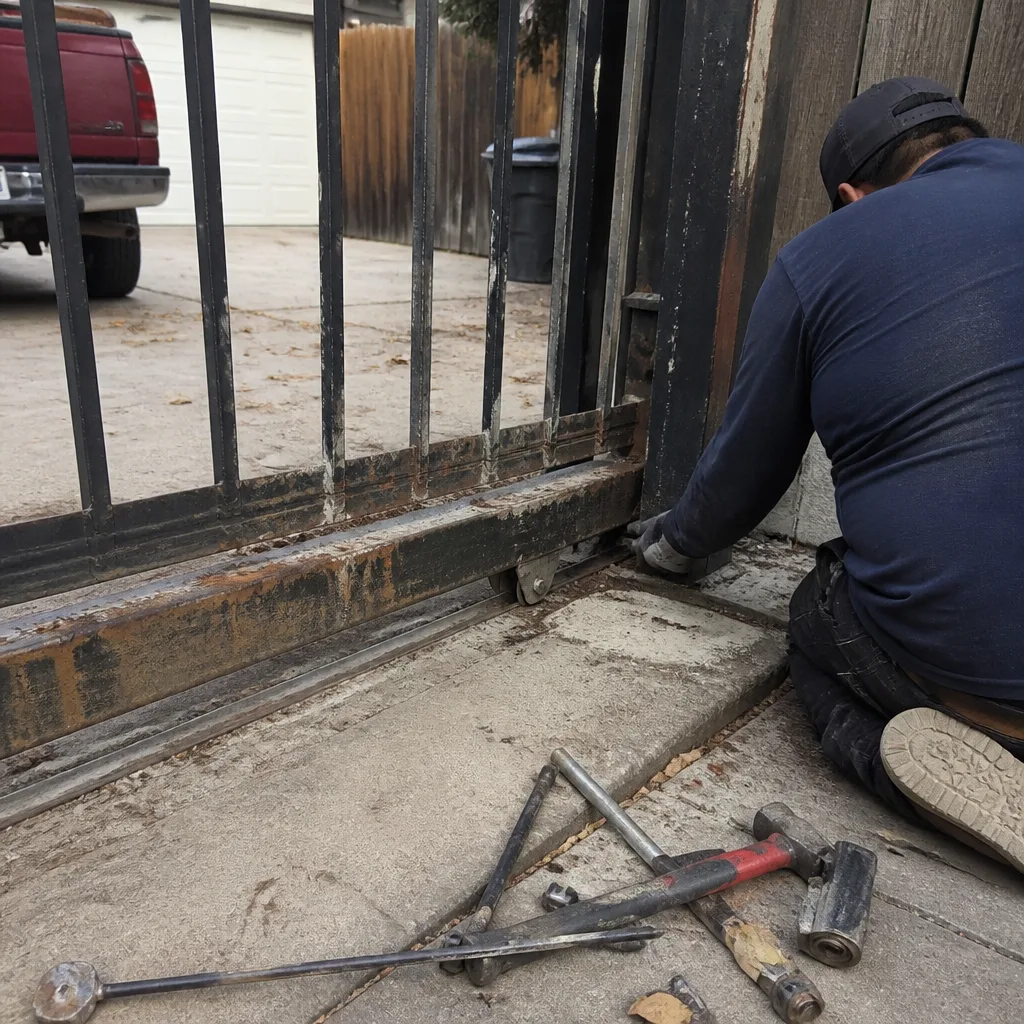 Before
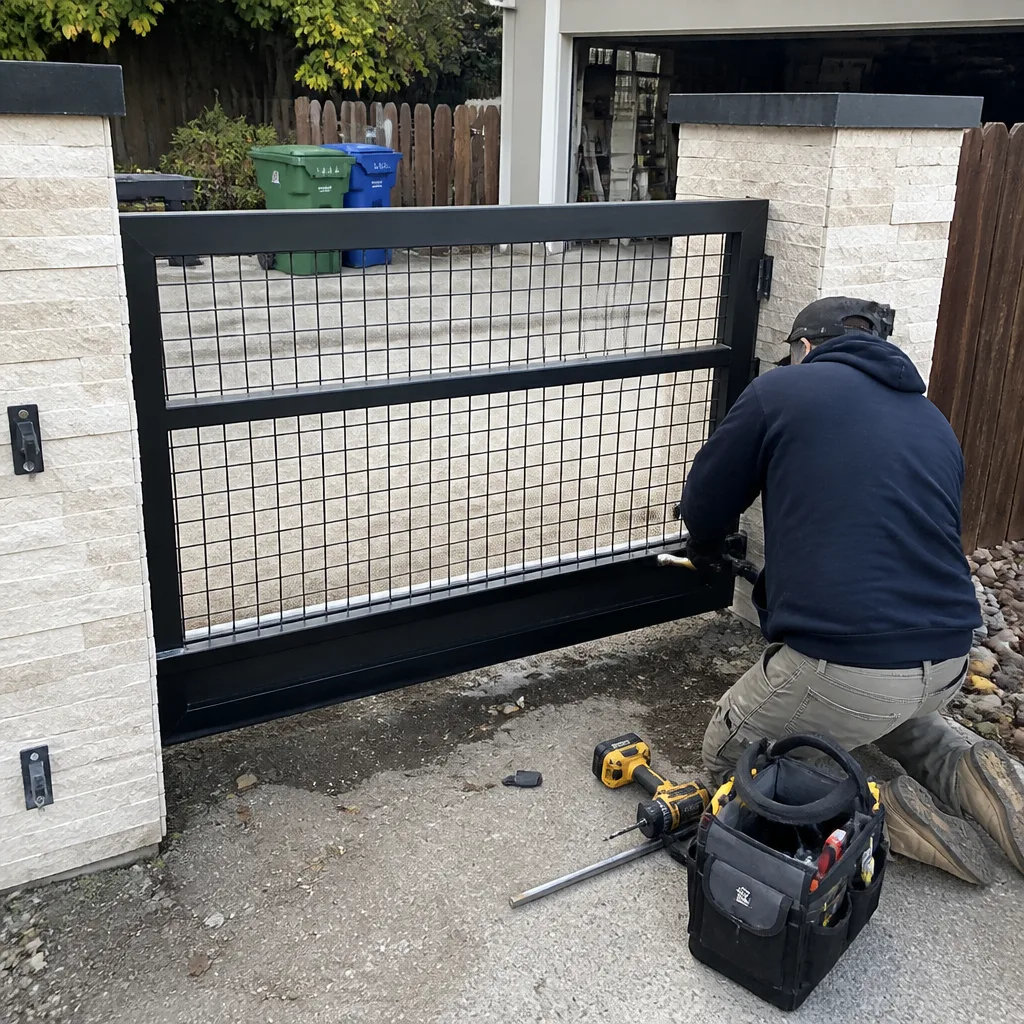 After
Seasonal Gate Maintenance for Pocket’s Climate
Pocket has two maintenance seasons: pre-summer (April and May) and post-summer (October and November). Each one has specific tasks that prevent the most common failures we see. This is the same checklist we use when we perform maintenance for homeowners who want to avoid emergency calls.
Spring Maintenance (April-May)
- Lubricate all pivot points with high-temperature grease rated for 200°F or higher. Standard grease runs out by July in Sacramento heat.
- Check and tighten every fastener on hinges, brackets, actuator mounts, and operator mounting bolts. Vibration and thermal cycling loosen everything over time.
- Test the safety sensors by blocking the photo eye path with a box and ensuring the gate stops or reverses. Do this at midday when sun glare can false-trigger sensors.
- Inspect the control board and wiring for scorch marks, swollen capacitors, or rodent damage. Pocket’s mature landscaping means more tree rats and squirrels near gate wiring.
- Clear drainage around gate posts and operator housings. Standing water softens soil and accelerates post settling.
Fall Maintenance (October-November)
- Re-lubricate everything – summer has stripped the lubricant you applied in spring.
- Check the gate leaf for fresh warping or cracks, especially at weld points and where the gate attaches to the hinges. Thermal expansion stress accumulates over the summer.
- Test the operator’s force settings. If the gate has to push harder to close in cool weather, the limit switches may need seasonal adjustment.
- Inspect battery backup units if you have one. Summer heat shortens battery life, and a battery that’s marginal in October will fail on the first cold morning.
- Check post alignment with a level before winter rains saturate the soil and accelerate any settling that started over summer.
Two maintenance passes a year prevent about 70% of the emergency repairs we respond to in Pocket. The gates that fail hardest are the ones that haven’t been touched since installation.
Common Mistakes to Avoid
- Overtightening hinge bolts to “fix” a sagging gate. If the post has shifted, overtightening just strips the threads and makes the real repair more expensive. If the gate sags, the post or hinge is compromised, not the bolt.
- Replacing the operator without checking post alignment. This is the most expensive mistake we see in Pocket. A new operator on a crooked post fails the same way the old one did, just slower.
- Ignoring slow gate movement. A gate that moves slower than it used to is telling you something. By the time it stops completely, the root cause has been stressing the whole system for months.
- Using WD-40 on gate hinges and bearings. It’s a solvent, not a lubricant. It strips grease and leaves the joint drier than before. Use a proper high-temperature bearing grease.
- Disabling safety sensors to make the gate work. An edge sensor that keeps tripping is misaligned or failing, and bypassing it creates a real crushing hazard. This is especially dangerous on heavier commercial-style gates in Pocket’s newer developments.
- Assuming the gate brand determines the repair parts. The operator brand matters, but the gate itself (the leaf, hinges, wheels) is usually a separate manufacturer. We work on LiftMaster, FAAC, BFT, and Linear operators attached to gates from completely different companies. The fix has to account for both.
- Waiting until the gate fails completely to call someone. A gate that’s intermittent, noisy, or slow is failing in slow motion. Catching it early usually means a cheaper repair and no security gap.
When to Call a Professional
Some gate repairs are genuinely simple, like replacing a remote battery or clearing debris from the track. But most failures involve high-tension springs, heavy gate leaves, low-voltage wiring, or capacitor banks that retain dangerous charge even when the power is off. If your gate uses a torsion spring for assist (common on heavier swing gates), never attempt to adjust or remove it yourself – these springs store enough energy to cause serious injury if they release unexpectedly. If the gate is binding, humming without moving, or tripping a breaker, call a gate specialist who can diagnose the system safely. Gatehouse Gate Repair offers free estimates in Pocket – call (833) 620-5971 and we’ll identify the actual problem before quoting a repair.
Frequently Asked Questions
Simple repairs in Pocket – sensor realignment, limit switch adjustment, remote reprogramming – typically run $150 to $300. Component replacements like a new control board or actuator run $400 to $750. Full operator replacement with installation runs $800 to $1,800 depending on the operator brand and gate weight. These ranges reflect what we see in this specific market, not national averages. Call (833) 620-5971 for a precise quote on your specific gate – the estimate is free and the price is agreed before any work starts.
Yes. Our Gate Repair services cover existing gates and operators from nine major brands, including LiftMaster, FAAC, BFT, and Linear. We’re brand-agnostic on repairs – we fix what you have rather than steering you toward a replacement you don’t need. If repair won’t last, we’ll tell you that too, and we’ll show you why before recommending replacement.
A gate that opens halfway and stops is usually tripping a safety sensor, hitting an obstruction the sensors detect, or failing because the limit switches are out of adjustment. In Pocket’s summer heat, false sensor trips from sun glare are common on west-facing gates. If the problem persists after checking for obstructions, the control board or limit switch itself may be failing, and that’s a diagnosis call, not a DIY fix.
Grinding is almost always mechanical, not electrical: a hinge that’s run dry, a wheel bearing failing, or an actuator gear that’s stripped or out of mesh. In Pocket’s climate, lubrication fails fast in summer, and what starts as a squeak becomes grinding by August. Address it early. Grinding means metal-on-metal contact, and every cycle is removing material that can’t be replaced.
A quality residential operator installed in Pocket lasts 7 to 10 years with proper maintenance, but heat stress, dust, and heavy usage can cut that to 5 years or less. Gates on south-facing installations with black operator housings fail sooner than shaded or light-colored installations. Two-season maintenance extends operator life meaningfully in our climate.
Yes. We service both single-family driveway gates and shared HOA entry gates throughout Pocket, including systems with vehicle loop detectors, keypad access, and intercom integration. HOA gates see higher cycle counts than residential gates, so we spec replacements for the actual duty cycle rather than just replacing like-for-like. Call (833) 620-5971 to schedule an evaluation.
The Bottom Line
Most Pocket gate failures are not random. They’re the predictable result of Sacramento Valley heat, soil settling in older subdivisions, and usage patterns that exceed what residential equipment was designed to handle. The homeowners who avoid repeat repairs are the ones who treat their gate as a system – operator, actuator, sensors, access control, and structural frame working as one – rather than swapping parts and hoping. If your gate is acting up, start with a true diagnosis, not a guess. That’s the difference between paying once and paying for the same repair again in six months. Gatehouse Gate Repair serves Pocket and the surrounding areas – call (833) 620-5971 for a free estimate and we’ll find the actual problem before anything gets replaced.
Written by the team at Gatehouse Gate Repair, serving Pocket since 2018. For more guides & resources, visit our blog.